SUPERIOR LIMB OSTEOLOGY:
The bones of a superior limb [membrum superioris] include the clavicle, scapula, humerus, radius, ulna, eight carpal bones, five metacarpal bones, and fourteen phalanges. Each of these have important landmarks associated with them. Attachments of muscles, tendons, fascia, nerves, etc. can be described where they originate or terminate through the use of these landmarks.
Clavicle
The clavicle, known on the street as the “collar bone” is a flat bone that bridges your sternum and scapula. It articulates medially with the clavicular notch of the sternum, and laterally, with the acromion of the scapula. Three distinguishable landmarks are the body of the clavicle, sternal extremity of the clavicle, acromial extremity of the clavicle, and conoid tubercle of the clavicle.
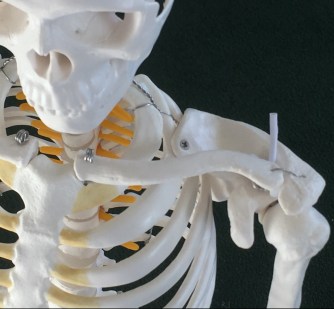
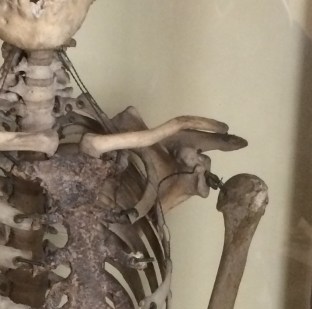
The body of the clavicle is the middle portion of the bone, the sternal extremity is the end that articulates with the sternum, and in similar fashion, the acromial extremity is that end that articulates with the scapula. The conoid tubercle is found postero-inferiorly as a projection near the bend closest to the acromial extremity.
Scapula
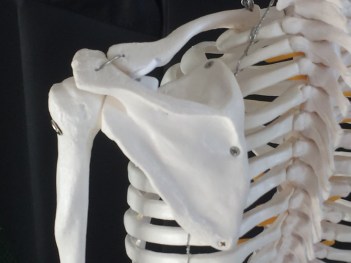
The scapula (also known as the shoulder blade), is a flat bone attached to the ipsilateral humerus and clavicle. Landmarks of the scapula are parented to the bone, for example: supraspinous fossa of the scapula. The landmarks covered in the lab guide include: anterior (costal) surface of the scapula, subscapular fossa, posterior surface of the scapula, spine of the scapula, supraspinous fossa of the scapula, infraspinous fossa of the scapula, acromion of the scapula, superior, medial, and lateral borders of the scapula, scapular notch, superior, lateral, and inferior angles of the scapula, glenoid cavity of the scapula, coracoid process of the scapula, and neck of the scapula.
Humerus
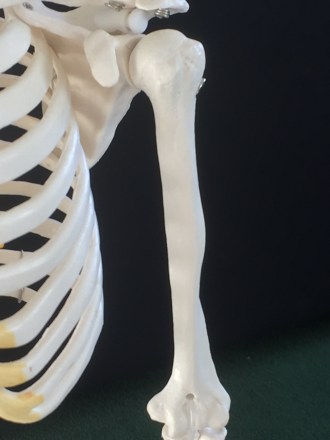
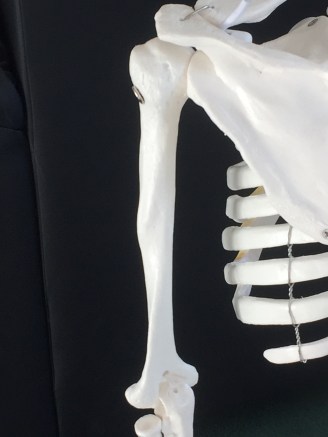
The humerus is the bone which makes up the arm. Anatomically the term “arm” is reserved for the upper part of the brachium spanning the length of the humerus. The several landmarks are: head of the humerus, anatomic neck of the humerus, surgical neck of the humerus, greater tubercle of the humerus, lesser tubercle of the humerus, intertubercular groove of the humerus, body of the humerus, deltoid tuberocity of the humerus, condyle of the humerus (humeral condyle), capitulum of the humeral condyle, trochlea of the humeral condyle, medial epicondyle, lateral epicondyle, lateral supracondylar crest of the humerus, olecranon fossa of the humerus, coronoid fossa of the humerus, and radial fossa of the humerus,
Ulna
The ulna might as well have been named the “humerus”, as it is in fact, the “funny bone” any unfortunate person is familiar with after having struck it against something. It’s named landmarks are: olecranon of the ulna, trochlear notch of the ulna, coronoid process of the ulna, radial notch of the ulna, body of the ulna, interosseous border of the ulna, head of the ulna, and styloid process of the ulna.
Radius
The radius is the second bone spanning the length of the antebrachium (forearm). Landmarks include: head of the radius, neck of the radius, body of the radius, radial tuberocity, interosseous border of the radius, carpal articular surface of the radius, styloid process of the radius, and ulnar notch of the radius.
Carpal bones
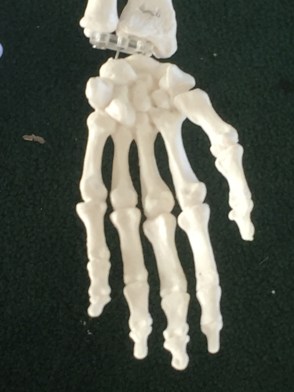
The eight carpal bones make up the bony portion of the wrist. A subtle indentation on the anterior surface of the bones, where nerves, ligaments, and other vessels run, is the carpal groove. The named carpal bones are: scaphoid bone, lunate bone, triquetral bone, pisiform bone, hamate bone, capitate bone, trapezoid bone, and trapezium bone. A helpful pneumonic I learned to remember them all, was “So long the pinky, here comes the thumb!” Starting with the scaphoid bone and moving medially, once you reach the pisiform bone, come back to the thumb. Think of the “m” in trapezium and “m” in thumb.
Metacarpal bones
The five metacarpal bones are designated by number starting with the most lateral, attached to the base of the thumb and are named: first metacarpal bone, second metacarpal bone, etc. Each metacarpal bone has a base, body, and head, and are identified by saying for example “head of the first metacarpal bone” or “body of the third metacarpal bone”, etc.
Phalanges
Each hand contains 14 phalanges. The first digit only has two, with the others having three. Each phalanx (singular), has a base and body, similar to the naming convention of the metacarpal bones. Since there are three phalanges on digits two through five, they are designated as proximal, middle, and distal phalanges.
INFERIOR LIMB OSTEOLOGY:
Here is the second video in the Osteology series, this time, covering the bones of the inferior limb and their major landmarks. Information is taken from the Anatomy Lab Guide written by Michael J. Shively and Don P. Homan at Utah Valley University and based on the nomenclature found in the Nomina Anatomica.
Bones covered in the video are hip bone, bony sacrum, femur bone, tibia, fibula, tarsal bones, metatarsal bones, and phalanges. Each with their major landmarks is named and described. I loved learning the bones in Anatomy since a knowledge of them not only gives one, much understanding of body structure but also because they have unique and interesting names.


Since working in Central Service, I’ve really been able to better understand and appreciate those things I’ve learned in school. Just the other day I was talking to a sales rep for a surgical instrumentation company about the benefits and disadvantages of certain metals used in knee replacements. Pictured above is a genual (knee) joint. I was told that with knee replacement procedures, Titanium has a tendency to promote excellent bone growth whereas stainless steel seems to inhibit it. When replacement stainless steel condyles are removed from patients, rarely is there much bone growth. On the other hand, when Titanium pieces are used, such as intramedullary nails, surgeons rely on bones producing attachments to strengthen the artificial joint, utilizing the knowledge of how the body reacts differently to these metals.
AXIAL OSTEOLOGY:
The axial skeleton comprises the bones of the head, vertebral column, and the thoracic cage.
 Joshua Wilson